Australian Shepherd
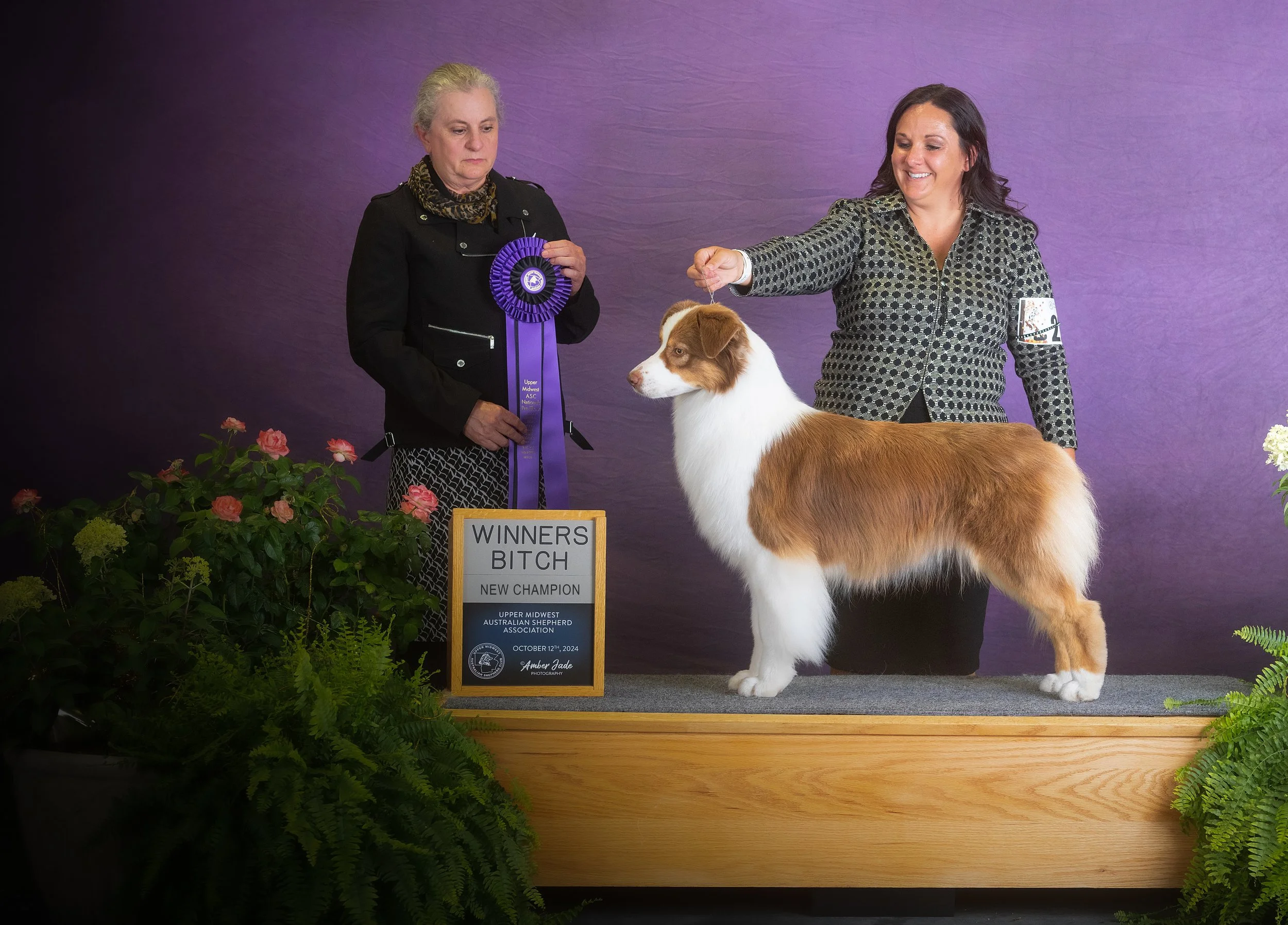
Bred-by Australian Shepherd competing in ASCA conformation
The Australian Shepherd is a versatile, intelligent herding breed developed in the United States to work livestock across varied terrain. Known for athleticism, trainability, and deep loyalty to their people, the breed balances grit and sensitivity in a way that makes them both capable working partners and devoted companions.
We actively participate in both AKC and ASCA venues, breeding with the standard in mind and selecting for structure, sound movement, stable temperament, and longevity. While many of our puppies are placed in companion homes, the goal is always to preserve correct type and the qualities that define the Australian Shepherd as a true working breed.
Purpose & Working Heritage
The Australian Shepherd was developed in the United States as a versatile stock dog, capable of working livestock across varied terrain with endurance, intelligence, and adaptability. Though often seen today in conformation rings and family homes, the breed’s foundation remains rooted in functional movement, sound structure, and strong instinct.
Within our program, we value both working heritage and correct conformation. Our lines include dogs that have proven themselves in the show ring as well as those with natural instinct and work ethic. We do not see these qualities as opposing goals. Sound structure supports endurance and longevity. Stable temperament supports trainability. Correct type preserves identity.
Whether in the field, the ring, or the home, the aim is the same: balance, resilience, and partnership.
History & Registry Development
Despite its name, the Australian Shepherd was developed in the western United States among ranchers and stockmen who needed an intelligent, resilient, and adaptable stock dog. The breed’s ancestors are closely associated with Basque shepherds who traveled to the American West with sheep that had previously been imported from Australia. Over time, the dogs working alongside these shepherds became known as “Australian Shepherds,” even though the breed itself was shaped and refined in America.
The first formal registry to record Australian Shepherds was the National Stock Dog Registry (NSDR), established in the 1950s. Shortly thereafter, the Australian Shepherd Club of America (ASCA) was formed in 1957 to promote and preserve the breed. In its early decades, development was closely tied to practical ranch work and public performance. Well-known demonstration dogs, including the Sisler dogs, showcased the breed’s athleticism, intelligence, and trainability in rodeo exhibitions and working demonstrations, helping bring broader national attention to the Australian Shepherd.
From the beginning, the breed was valued not only for physical ability, but for mental balance. A capable stock dog required initiative and grit, yet also responsiveness and partnership with its handler. That combination of independence and biddability remains central to correct Australian Shepherd temperament today.
As the breed gained popularity, structured preservation through ASCA and later recognition by the American Kennel Club introduced formal conformation standards. For many years, ASCA maintained its own registry and performance programs independently before the Australian Shepherd was accepted into the AKC Herding Group in 1993, reflecting the breed’s expanding national presence.
Over time, selection pressure has shaped different lines within the breed. Breeders focused primarily on stock work have continued to prioritize instinct, endurance, and working drive. Others, emphasizing conformation, have selected for adherence to the written standard, balance, and ring presence. As in many established breeds, emphasis in either direction can influence style, expression, and degree of drive.
While lines may vary in focus, the foundation of the Australian Shepherd remains rooted in functionality, partnership, and versatility.
Breed Standard & Structure
The Australian Shepherd is a medium-sized, balanced herding breed built for real work. Slightly longer than tall, they should give an overall impression of strength, agility, and endurance without extremes. Nothing about the breed should feel exaggerated or fragile. Everything should look purposeful.
Structure matters because it supports longevity. A dog built with balanced angulation, a firm topline, and proportionate bone can move efficiently and stay comfortable over time. Correct structure is not about aesthetics. It is about function. A well-built Aussie should be able to move livestock for hours, navigate uneven terrain, turn quickly, and maintain stamina without breaking down physically over time.
Size, Proportion & Substance
Aussies should feel solid and capable without appearing heavy. Bone should be moderate and proportional to body size. Too much refinement can compromise durability, while excessive bulk can limit agility and endurance.
Proportion is important. The breed should be slightly longer than tall, which contributes to balance and flexibility in motion. Front and rear angulation should complement each other. When a dog is balanced, it stands comfortably and moves without wasted effort.
Males should reflect masculinity without coarseness. Females should appear feminine without looking slight or fragile. In both, the impression should be strength without exaggeration.
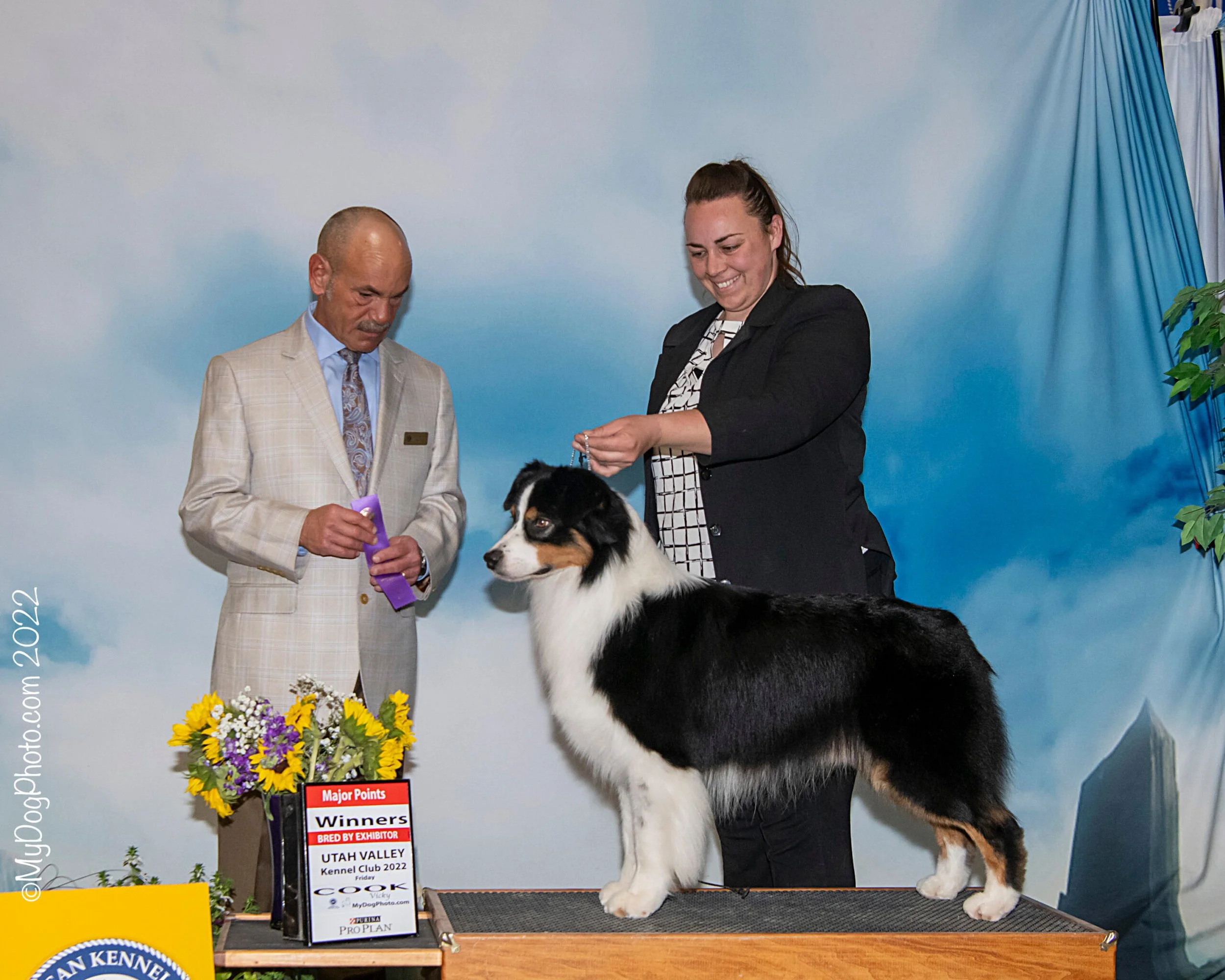
CH ASCA CH UCH Prestige Black Label - Male Australian Shepherd
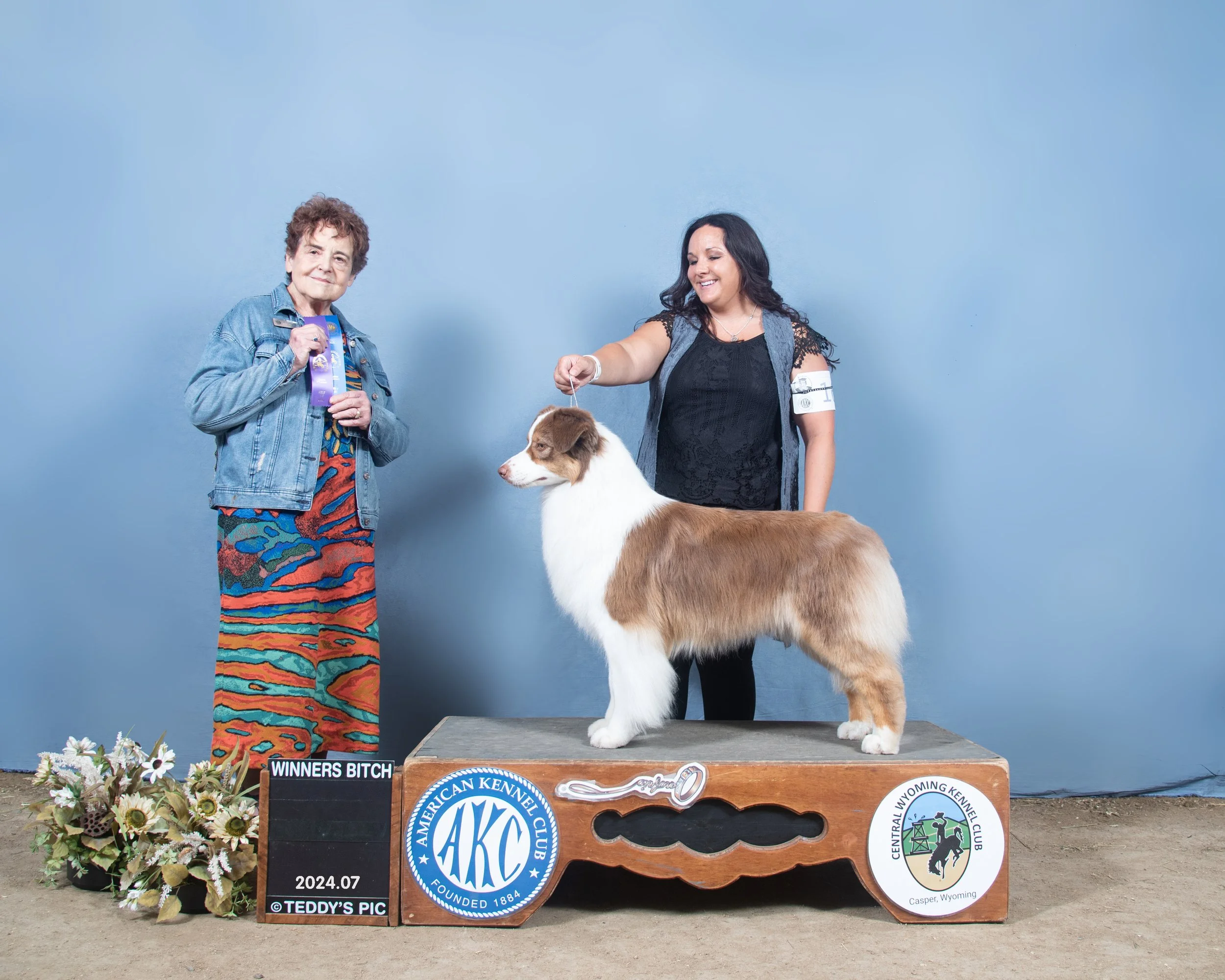
AKC PTD ASCA CH UCH Painted Blue’s Say you Love Me - Female Australian Shepherd
Topline, Body & Balance
The topline should remain firm and level when standing and moving. A strong back and well-developed loin support endurance and stability. The croup should be moderately sloped, allowing for efficient rear drive.
Depth of body should reach the elbow, with well-sprung ribs that provide room for heart and lung capacity. This is a working breed. Internal capacity matters just as much as external outline.
Overall, the dog should appear balanced from nose to tail. No one feature should overpower the rest.
Head & Expression
The Australian Shepherd head should be clean-cut, strong, and proportionate to the body. It should never appear coarse or heavy, nor overly refined. Balance is key. The muzzle is equal in length or slightly shorter than the back skull, with parallel planes when viewed from the side and a moderate, well-defined stop. The muzzle tapers only slightly and finishes in a rounded tip rather than appearing snipy or sharp.
The skull is flat to slightly domed, with length and width approximately equal. When correct, the head feels harmonious and functional rather than stylized.
Expression is one of the defining characteristics of the breed. An Australian Shepherd should look attentive, intelligent, and eager. The gaze should be keen but friendly. There should be awareness without hardness and alertness without anxiety.
Eyes are almond-shaped and set obliquely, never protruding or sunken. They may be brown, blue, amber, or any combination thereof, including flecks or marbling. Pigmentation corresponds with coat color, with black pigmentation on blacks and blue merles, and liver pigmentation on reds and red merles.
Ears are triangular, moderate in size, and set high on the head. When attentive, they should break forward and over or to the side as a rose ear. Fully erect or hanging ears are considered incorrect.
A full complement of strong teeth meeting in a scissors bite is preferred, though a level bite is acceptable. Overall, the head should reflect the breed’s heritage as a capable working dog. It should look intelligent, thoughtful, and ready to respond.
The Australian Shepherd is not an extreme head breed. Harmony and proportion matter far more than exaggeration of any single feature.
Movement
Movement is where structure reveals itself.
The Australian Shepherd should move with a smooth, easy stride that looks efficient rather than flashy. Reach in the front should be balanced by drive from the rear, with neither end overpowering the other. When angulation is correct and proportion is balanced, the dog covers ground comfortably without wasted motion.
From the side, the topline should remain firm and level as the dog moves. There should be no rolling, bouncing, or excessive lift. The stride should look natural and sustainable, as though the dog could continue working over distance without strain.
Coming and going, the legs travel straight and true. As speed increases, the feet naturally converge toward a center line, reflecting balance and efficiency. The hocks remain strong and parallel, and the elbows stay close to the body without looseness.
Correct movement is not just about appearance in the show ring. It reflects structural integrity and long-term soundness. An Aussie built properly should be capable of quick turns, bursts of speed, and sustained effort across uneven terrain.
When you watch one move correctly, nothing looks forced. It simply looks right.
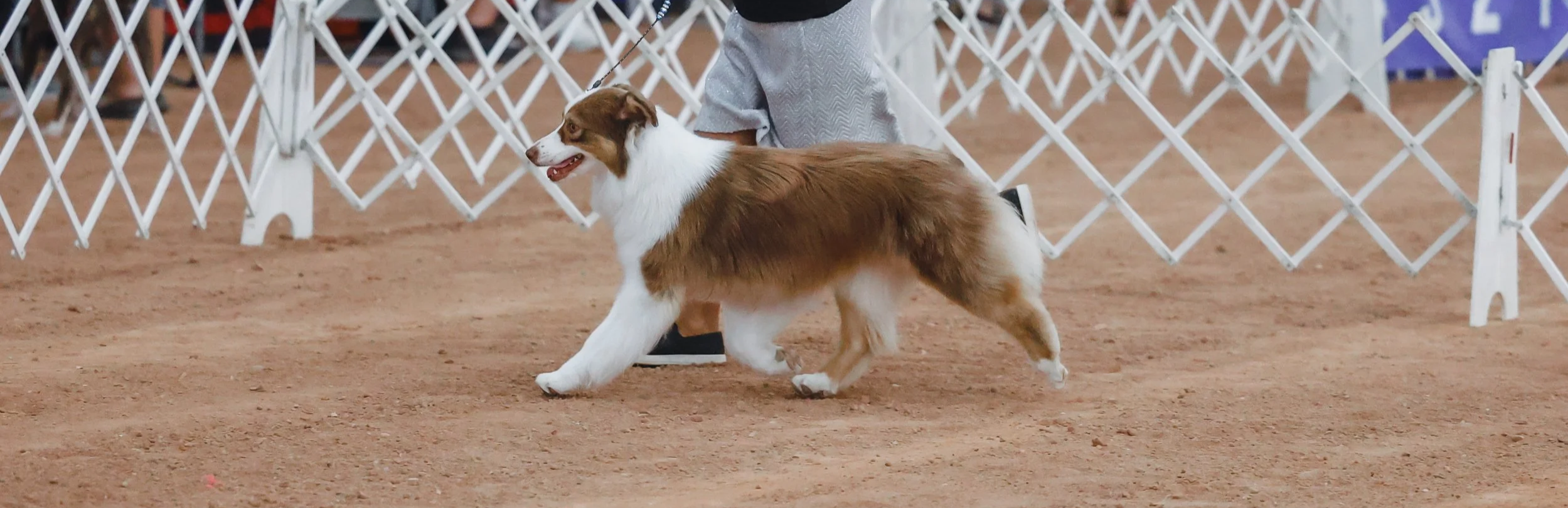
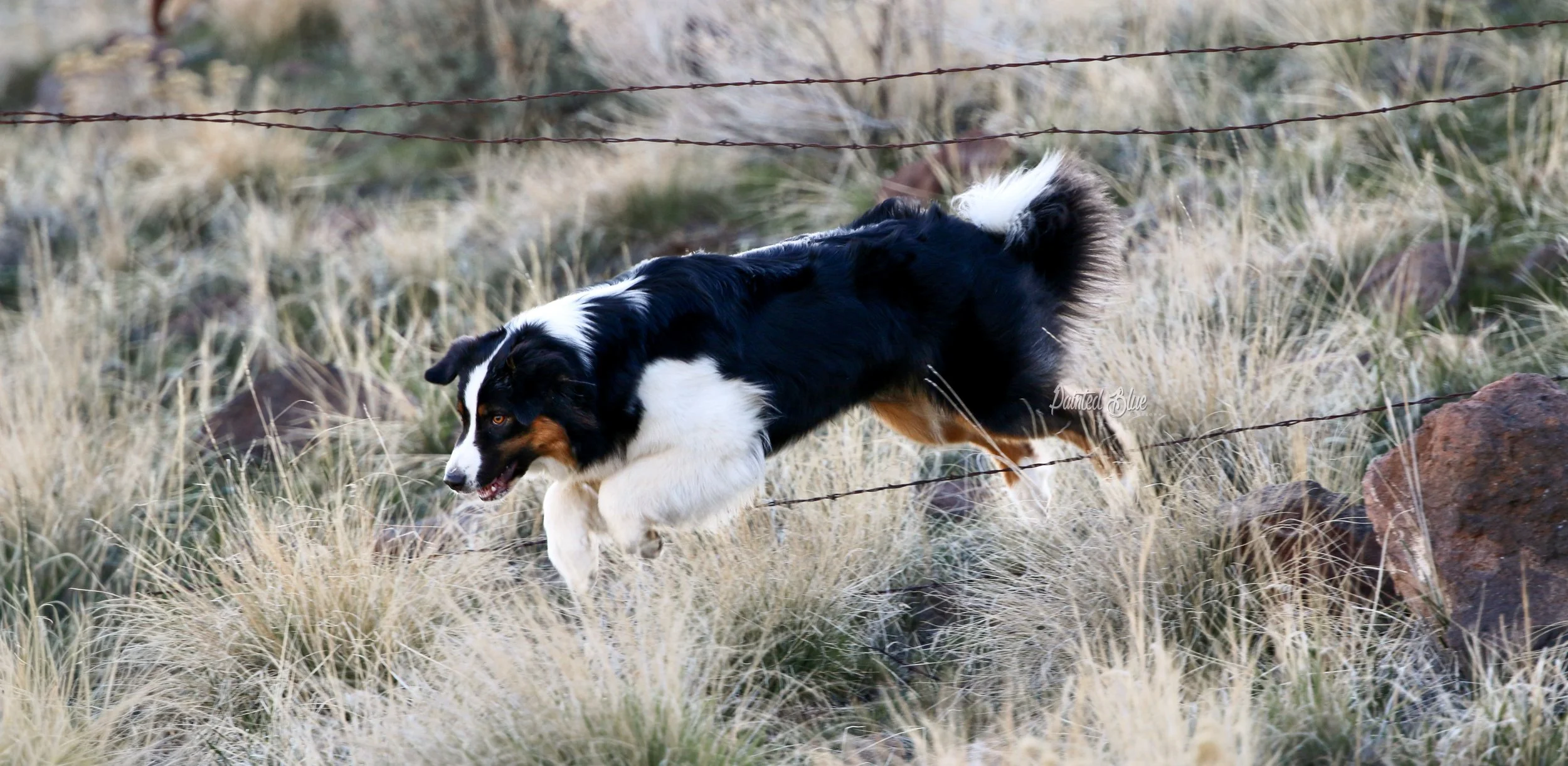
Marzipan moving with balanced reach and drive, covering ground easily while maintaining a steady topline.
Tail
Traditionally, the Australian Shepherd has been docked or naturally bobtailed, and docking remains common practice within the breed in the United States. The AKC standard describes a docked or natural bobtail not to exceed four inches. A full tail is considered a fault under the AKC standard, though it is not a disqualification.
A fault simply indicates a deviation from the written standard and is evaluated in context. Structure, movement, balance, and temperament remain more significant in assessing overall quality than any single cosmetic feature.
Unlike some international standards, the current U.S. standard does not describe a specific tail set or carriage. In countries such as Canada and parts of Europe, where docking is restricted or prohibited, full tails are addressed more directly within their standards.
Within our program, we have both docked and natural dogs. I personally appreciate a full tail and the expression it adds to the dog, while also respecting the longstanding culture of docking within the breed. Some litters or individual puppies may be docked depending on circumstances and placement goals.
As with many aspects of the breed, balance, structure, and overall soundness remain the greater priorities.

“Lucy” running on the hill.
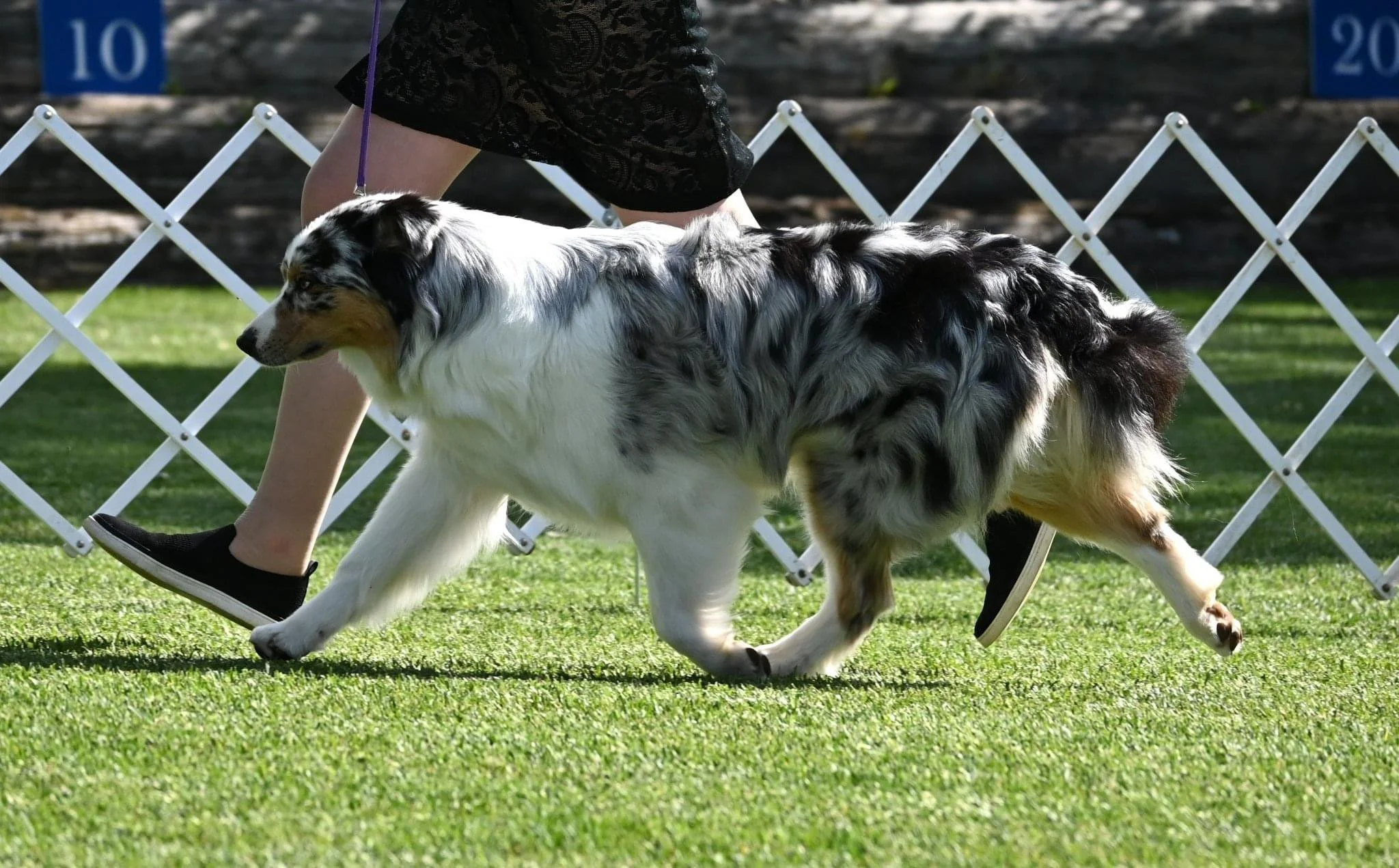
Story’s tail carriage when moving in the ring.
Evaluation & Thoughtful Placement
Every puppy develops at its own pace, and not every well-bred dog will grow into a show prospect. While the breed standard provides a guide for structure, movement, and type, young puppies are still growing and changing. Careful evaluation helps us determine which puppies may be best suited for conformation or future breeding, and which are better placed as beloved companions.
In our program, we look at the whole dog. Structure, movement, temperament, health, and overall balance all play a role in placement decisions. Occasionally a puppy may show the qualities needed for the show ring or a future breeding program, but the majority of puppies are placed in companion homes where they can simply enjoy life as a cherished family member.
A puppy does not need to be a show prospect to be a wonderful dog. Many small variations that place a dog outside the show ring have little to no impact on their ability to live a happy, healthy life.
Thoughtful placement is about matching the right dog to the right home. Some families are excited about learning the world of dog shows or performance sports. Others are simply looking for a loyal companion to share everyday life. Both are valuable homes, and both play an important role in the future of the breed.
Temperament & Trainability
The Australian Shepherd is known for intelligence, loyalty, and a strong desire to work alongside its people. These are dogs that form close partnerships with their families. They tend to be very aware of their surroundings and highly responsive to the tone and energy of the people around them.
Aussies are often described as eager to learn and highly trainable. Many are naturally motivated by food, praise, and engagement, which makes training both productive and enjoyable. They tend to thrive when given opportunities to learn new skills and participate in activities with their family.
Like any intelligent breed, they benefit from thoughtful leadership and clear expectations. When a dog understands its role within the household, confidence and stability tend to follow. Training, structure, and positive experiences help young dogs grow into well-adjusted adults.
While the breed standard describes the Australian Shepherd as reserved with strangers, personalities can vary. Some dogs are naturally more outgoing and social, while others may take a little time to warm up to new people. Both responses can be normal within the breed as long as the dog remains confident and stable.
Above all, Aussies are dogs that want to be involved in daily life. They are happiest when included in family routines, learning alongside their people, and forming the close bonds the breed is known for.
Energy & Engagement
Australian Shepherds are an active and intelligent breed, but energy levels can vary more than people sometimes expect. Within the breed you may see dogs with lower, moderate, or higher drive depending on the individual dog and the lines behind them.
Most Aussies enjoy having something to do, whether that’s learning new skills, going on walks, playing games with their family, or participating in activities like agility, nose work, or obedience. They tend to thrive when their minds are engaged just as much as their bodies.
It is easy to assume that a high-energy breed simply needs more and more physical exercise, but that approach can sometimes create a dog that struggles to settle. Teaching young dogs how to relax, self-soothe, and enjoy quiet time is just as important as providing outlets for activity.
Many Australian Shepherds develop a natural “off switch” when their needs for engagement and structure are met. A walk, a short training session, or a game of fetch may be enough to satisfy their need for activity before happily settling down with their family.
As with temperament, thoughtful matching plays an important role. Some dogs may be best suited for highly active homes or performance sports, while others are perfectly content participating in everyday family life.
Working Instinct & Awareness
The Australian Shepherd was developed as a stock dog, and many still carry a natural awareness of movement and environment that reflects that heritage. Even in companion homes, it is common to see glimpses of this instinct in the way they observe activity around them.
Many Aussies are naturally attentive to the people and animals in their environment. They tend to notice patterns, routines, and movement quickly. This awareness is part of what makes the breed so responsive in training and capable in activities that require focus and communication with their handler.
In everyday life, this instinct may appear in simple ways. Some dogs may try to organize play with other dogs, keep track of children in the yard, or position themselves where they can see what everyone is doing. This attentiveness is often part of the breed’s charm.
With guidance and appropriate outlets, these instincts can be channeled into positive activities such as obedience, agility, herding, scent work, or other structured training. Even simple training games and problem-solving exercises can help satisfy a dog’s natural desire to think and engage.
For many families, this working awareness simply translates into a dog that is observant, responsive, and closely connected to the people it loves.
Social, Reserved, and Everything In Between
The Australian Shepherd standard describes the breed as reserved with strangers, though in everyday life temperament can fall across a spectrum. Some Aussies are naturally outgoing and happy to greet new people right away, while others prefer to observe first before deciding how they feel about a situation.
Much of this variation comes down to genetics, selection, and individual personality. Even within thoughtfully bred litters, puppies may show different social styles. One puppy may confidently approach new people, while another may hang back briefly before joining in. Both responses can be normal as long as the dog remains confident, stable, and not driven by fear.
Environment and leadership also play an important role. Dogs who feel secure in their handler’s guidance often navigate unfamiliar situations with greater ease. Clear expectations, thoughtful exposure, and calm leadership help young dogs develop the confidence needed to handle the world around them.
When choosing an Australian Shepherd, it is important to look at the individual puppy rather than expecting every dog to behave the same way. A more reserved puppy may thrive in a quieter home, while a highly social one may enjoy a busy household with frequent visitors and activity. Matching temperament to lifestyle helps create the best long-term partnership for both the dog and the family.
Ideal Homes & Roles
At Home with an Australian Shepherd
Living with an Australian Shepherd often means sharing your space with a dog that is constantly aware of what is happening around them. Aussies tend to notice everything — the opening of a door, the change in household routine, the moment someone reaches for the leash. That awareness is part of what makes them such responsive partners.
While the breed was developed for work, most Aussies today live primarily as companions. In the home they often become steady observers of family life, choosing a spot where they can keep an eye on things or quietly following their people from room to room. Many enjoy physical closeness, leaning against their person or settling nearby once the day slows down.
With thoughtful training and supervision, they can be wonderful with children. Their intelligence and willingness to engage often make them enthusiastic participants in family activities, whether that’s helping a child practice obedience exercises, accompanying the family on outings, or simply being present during everyday routines.
A secure yard can be helpful, but Australian Shepherds are not dogs that thrive when left outside to entertain themselves. They are thinkers and problem solvers. If they find a weak spot in fencing, it is often less about escaping and more about curiosity or a desire to reconnect with their people.
Many Aussies enjoy learning and activity throughout their lives. Training sessions, outdoor adventures, and shared experiences help channel their natural attentiveness into positive outlets. When their minds are engaged and their environment is stable, they often settle comfortably into the rhythm of the household.
Companion Homes
Many Australian Shepherds thrive as devoted family companions. They do best in homes where they are included in everyday life rather than treated as a backyard dog.
While they can spend short periods of time in a secure yard or run when the family is busy, they are not a breed meant to live outside or be left alone for long stretches as their primary lifestyle. Their strong attachment to their people means they tend to flourish when they are part of the household routine.
Families who enjoy interaction, structure, and shared activities often find Aussies incredibly rewarding. Whether it’s neighborhood walks, backyard play, training sessions, or simply participating in daily life, they tend to enjoy being involved.
Performance & Active Homes
For families interested in training and sport, the Australian Shepherd offers tremendous versatility. Many excel in activities such as agility, obedience, rally, herding, nose work, and other dog sports that allow them to use both mind and body.
Higher-drive individuals especially benefit from structured outlets and clear goals. These activities strengthen the partnership between dog and handler while providing healthy mental and physical engagement.
Show, Sport, & Breeding Homes
Occasionally, a puppy may be placed in a show or preservation-minded home. These placements require an understanding of structure, development, and the responsibility that comes with representing the breed.
Not every well-bred puppy will follow this path. Careful evaluation helps determine which individuals may be suited for conformation, sport, or potential future breeding, and which are best placed in companion homes.
Not the Best Fit For
Australian Shepherds may not be the best match for households seeking a completely independent or low-engagement dog. Long periods of isolation, inconsistent expectations, or minimal interaction can be frustrating for a breed that naturally thrives on partnership and communication.
They do not require constant activity, but they do benefit from connection, guidance, and participation in family life.
When matched thoughtfully, the Australian Shepherd adapts beautifully. The goal is not finding a perfect dog, but finding the right partnership between dog and home.
Health Testing & Longevity
Health & Genetics
The long-term health of the Australian Shepherd is an important responsibility for breeders and owners alike. Like all breeds, Aussies have certain conditions that can occur within the population. Responsible breeding programs use available health screening and genetic testing to better understand risk and make thoughtful breeding decisions.
Organizations such as the Australian Shepherd Club of America (ASCA), the United States Australian Shepherd Association (USASA), and the Canine Health Information Center (CHIC) provide guidance on recommended health testing and ongoing research within the breed.
Health testing does not guarantee that a dog will never experience health concerns, but it allows breeders to make more informed decisions and reduce risk over time.
Core Health Screening
Several health evaluations are commonly recommended for Australian Shepherd breeding dogs. These help identify potential structural or inherited conditions that may affect the breed.
Common screening includes:
• Hip Dysplasia Evaluation (OFA, PennHIP, or similar radiographic evaluation)
• Elbow Dysplasia Evaluation
• Annual Eye Examination performed by a board-certified veterinary ophthalmologist
• MDR1 Genetic Testing (multi-drug sensitivity)
• PRA-prcd Genetic Testing (Progressive Retinal Atrophy)
• HSF4 Genetic Testing (Hereditary Cataracts)
These screenings help breeders better understand the health status of their dogs and make informed pairing decisions.
Additional Genetic Screening
As genetic science advances, additional tests are available that help breeders better understand the genetic makeup of their dogs. Some of the conditions that may be screened for include:
• Collie Eye Anomaly (CEA)
• Degenerative Myelopathy (DM)
• Hyperuricosuria (HUU)
• Intestinal Cobalamin Malabsorption (IGS)
• Multifocal Retinopathy (CMR1)
• Exercise Induced Collapse (EIC)
• Pelger-Huet Anomaly (PHA)
Not every test is relevant for every breeding decision, but these tools allow breeders to track potential genetic risks and maintain transparency about the health of their dogs.
Transparency & Documentation
Transparency is an important part of responsible breeding. Health testing results for our dogs are made publicly available through the Orthopedic Foundation for Animals (OFA) database and shared on our website. This allows prospective owners and fellow breeders to review health information directly.
Health testing recommendations and available genetic tests continue to evolve as research advances. Responsible breeders remain attentive to new information and adjust breeding decisions as our understanding of canine health grows.
Learn More
Learn more about how we approach health testing and genetics in our Australian Shepherd program by checking out our Australian Shepherd Health and Genetics page.
For those interested in exploring the technical details of health testing within the breed, the United States Australian Shepherd Association Health & Genetics program provides extensive educational resources and research updates.
Lifespan
Average lifespan: 12–15 years
The Australian Shepherd is generally a healthy and long-lived breed. Most Australian Shepherds live 12 to 15 years, with many remaining active, athletic, and engaged well into their senior years.
Longevity in this breed is influenced by both genetics and daily care. Responsible breeders prioritize health testing and thoughtful breeding decisions to reduce the risk of inherited conditions. Screening for orthopedic health, eye health, and known genetic concerns helps support stronger foundations for future generations.
Daily lifestyle also plays an important role. Maintaining a healthy weight, providing regular exercise and mental stimulation, and establishing consistent veterinary care all contribute to long-term health and quality of life.
Like all breeds, Australian Shepherds can be predisposed to certain inherited conditions. Responsible breeders work to reduce these risks through health testing and careful pedigree selection. Prospective owners should look for breeders who openly share health testing results and prioritize the long-term well-being of the breed.
At Painted Blue Aussies, health and longevity are central to our program. We carefully evaluate structure, temperament, and health testing results when planning breedings, with the goal of producing dogs that are not only beautiful and capable, but also able to live long, healthy lives as beloved companions.
The Australian Shepherd is an incredibly special breed. Their intelligence, loyalty, and willingness to work alongside their people is what has drawn so many of us to them in the first place. Whether they are helping on a ranch, competing in performance sports, or simply sharing daily life with their family, Aussies thrive when they have a purpose and a close partnership with their people.
Our goal is to honor the heritage of this breed by raising Australian Shepherds who are sound in mind and body, with stable temperaments and the ability to live full, active lives. Above all, we believe these dogs deserve thoughtful breeding, responsible care, and homes where they are truly valued as partners and companions.